
How is a one-phase implant-based mouth restoration ready in just 5 days?
Introduction
A one-phase implant-based mouth restoration offers a fast, predictable, and highly effective solution for patients who require complete oral rehabilitation. As the attached document states, “our main profile is one-phase implant-based mouth restoration, which performs under general anesthesia by an implant specialist.” This method is designed for individuals whose teeth can no longer be restored through traditional dental treatments and who need a full denture supported by implants. With modern surgical techniques, advanced imaging, and the expertise of a trained implantologist, a complete restoration can be completed in just a few days. This article explains what one-phase implant-based mouth restoration involves, what types of implants exist, why an implant specialist is essential, and how the entire process unfolds under general anesthesia.
What types of dental implants exist?
Dental implants are high-purity titanium alloy screws that function as artificial tooth roots. They integrate with the jawbone and provide a stable foundation for various types of dentures. Implant technology has advanced significantly in recent decades, making implant-supported restorations more predictable and durable than ever before. However, the relatively high cost of implants remains the main reason they are not even more widespread.
There are two primary implant families:
— Traditional two-phase implants,
— Immediate loading one-phase implants.
Both serve the same purpose—replacing missing teeth—but they differ significantly in design, surgical technique, and healing protocol. A skilled implantologist understands both systems thoroughly, although specialization is becoming increasingly common. As the document notes, “one implantologist becomes an expert in traditional two-phase implants, while the other becomes an expert in one-phase implants.” In our practice, we specialize exclusively in one-phase implant-based mouth restoration performed under general anesthesia, ensuring maximum comfort and efficiency for patients requiring full-mouth rehabilitation.
The importance of the implantologist
The success of any implant procedure depends on two key factors: the quality of the implant and the expertise of the implantologist. Even the best implant cannot compensate for insufficient surgical skill, and even the most experienced specialist cannot achieve optimal results with poor-quality materials. Becoming an implant specialist requires years of theoretical study, hands-on training, and extensive clinical experience.
In modern dentistry, it is increasingly common for oral surgeons to focus exclusively on implantology rather than general dental treatments. This level of specialization ensures that the implantologist is fully dedicated to mastering implant placement techniques, bone assessment, and prosthetic planning. In our clinic, the specialist responsible for one-phase implant placement works exclusively in implantology, ensuring consistent, high-quality results.
What is oral rehabilitation?
Oral rehabilitation—also referred to as mouth restoration—is necessary when the patient’s teeth can no longer be restored through conventional dental treatments. Although complete tooth loss is relatively rare, many patients have remaining teeth that are unsuitable for prosthetic care. In such cases, the remaining teeth must be removed before implant placement.
One-phase implant-based mouth restoration may be required even when some teeth are still healthy, but their number is insufficient to support a traditional denture. In most cases, however, the existing teeth are either damaged, unstable, or compromised by periodontal disease, making extraction the only viable option before implant placement.
Why choose a one-phase implant-based mouth restoration?
One-phase implants offer several advantages, especially for full-mouth rehabilitation: — They can be placed even in cases of significant bone deficiency, — They allow immediate loading, meaning the denture can be attached shortly after surgery, — They require only one surgical intervention, — They are ideal for patients seeking a fast, stable, and long-term solution.
Because the entire procedure is performed under general anesthesia, patients experience no pain or discomfort during the process. This approach is particularly beneficial for individuals with dental anxiety or those undergoing extensive oral rehabilitation.
How does one-phase implant-based mouth restoration under anesthesia work?
The procedure consists of two main phases:
1. Implant placement and creation of long-term temporary dentures,
2. Fabrication of the final permanent dentures.
First phase
— Personal consultation with the implantologist or oral surgeon,
— CT scan and panoramic X-ray to assess bone structure,
— Comprehensive oral examination focusing on bone and gum condition,
— Consultation with the anesthesiologist, including laboratory and EKG tests, (if anesthesia requested,
— General anesthesia,, (if requested,
— Removal of teeth unsuitable for prosthetic treatment,
— Preparation and placement of the required number of one-phase implants,
— Impression taking for long-term temporary dentures,
— Fabrication of long-term temporary dentures, which are fixed and not removable by the patient,
— Final control tests.
A healing period of approximately six months is recommended before the final dentures are made, although the permanent restoration should ideally be completed within one year.
Second phase — Consultation with the implantologist, — Panoramic X-ray to evaluate implant stability, — Detailed oral examination focusing on implant integration and gum health, — Impression taking for the final dentures, — Fabrication of the permanent porcelain dentures, which are fixed and not removable by the patient, — Final control tests.
Why an implant specialist matters
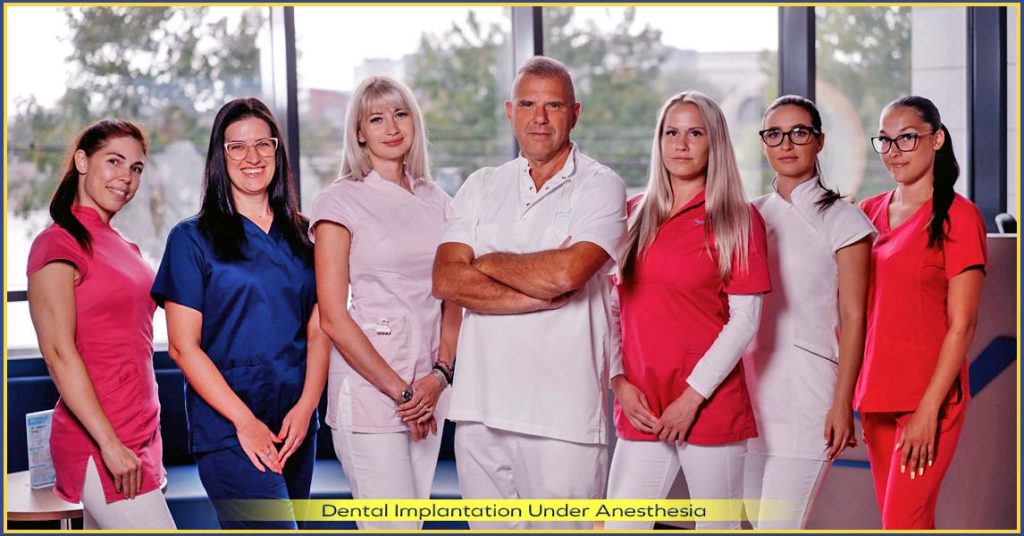
A one-phase implant-based mouth restoration is a significant investment, and patients rightly expect exceptional quality. The implantologist’s expertise is crucial not only for placing the implants correctly but also for ensuring long-term success. Perfect material knowledge, surgical precision, and extensive experience are essential for achieving predictable, durable results. Equally important is the support team—assistants and dental technicians must work in perfect coordination with the implantologist to ensure the highest standard of care.
Summary
A one-phase implant-based mouth restoration provides a fast, reliable, and highly effective solution for patients requiring complete oral rehabilitation. This method uses immediate loading implants placed under general anesthesia by an experienced implant specialist, ensuring comfort and precision throughout the process. The treatment consists of two phases: implant placement with long-term temporary dentures, followed by the fabrication of permanent porcelain dentures. With advanced imaging, specialized surgical expertise, and high-quality materials, one-phase implant-based mouth restoration offers a stable, long-term alternative to traditional dentures. For patients seeking a comprehensive, durable, and efficient solution, this approach represents one of the most advanced options available in modern implantology.
In our Articles section, there are many writings on the following topics: dentures with implants, dental implantation with one-phase and two-phase implants, and All-On-4 & All-On-6 technology.
We work with state-of-the-art dental tools, materials, and technologies.
30 years of experience, more than 35,000 successful implant placements, and a 99.7% success rate!
iliDent Patient Coordinator © Copyright 2026
ImmediateLoadingImplants.com


