
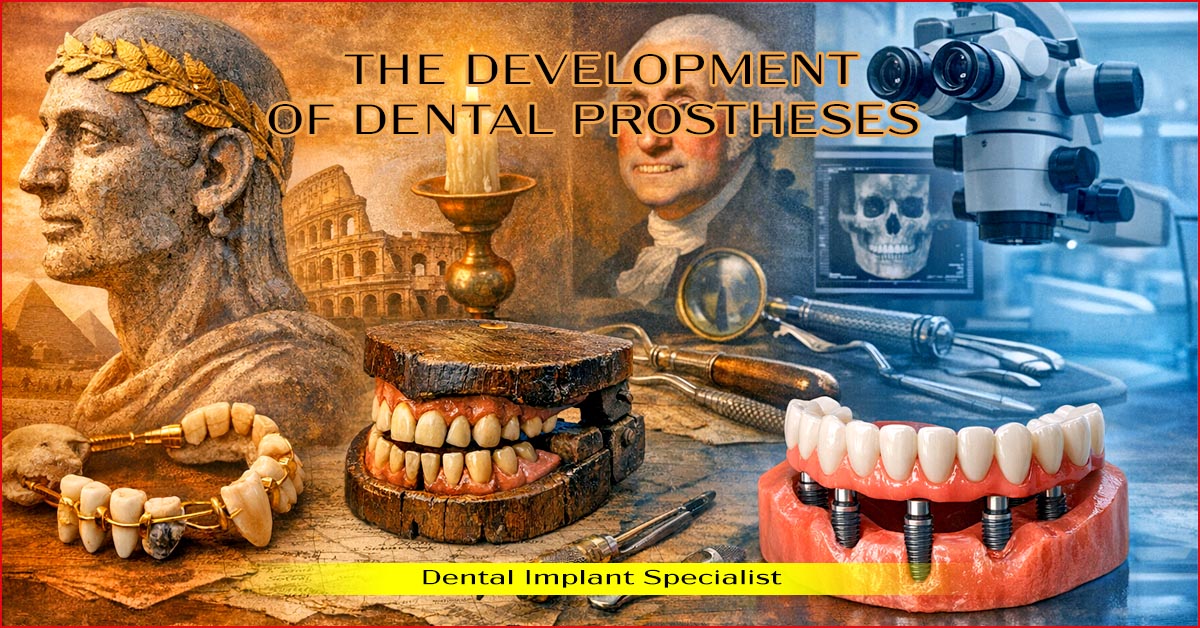
THE DEVELOPMENT OF DENTAL PROSTHESES FROM THE ETRUSCANS TO THE MODERN ALL ON 4 SOLUTION
The development of dental prostheses from the Etruscans to the modern All on 4 solution – Dentistry has existed for over 2000 years Introduction The
30 + YEARS OF EXPERIENCE – 35,000 + IMPLANTATIONS – 99.7% SUCCESS RATE!
Healthy teeth are far more than a detail of appearance — they are the foundation of confidence, comfort, and overall well‑being. When teeth are strong and cared for, everyday life feels easier: speaking clearly, enjoying meals, and feeling secure in social situations all come naturally.
Unfortunately, many people only realize the importance of oral care once problems have already led to tooth loss. This can affect not just health, but also self‑assurance and quality of life. The most advanced solution available today is dental implant treatment.
Dental implants provide a natural‑looking, durable, and reliable way to replace missing teeth. They restore function, stability, and aesthetics in a way that traditional methods cannot.
In this article, we’ll explore the essentials of implant‑based tooth replacement, answer the most common patient questions, and show how this treatment can truly transform everyday living.
The one‑phase dental implant is a special type of implant system. Its two most important features are:
— Unlike the traditional two‑phase method, it is placed in a single surgical step.
— It can be loaded immediately after placement, meaning patients can begin using their new teeth right away.
Beyond these, one‑phase implants offer additional advantages, but here we will focus on the treatment process itself.
The Two Stages of One‑Phase Implant Rehabilitation
First Visit – IMPLANT PLACEMENT
— Personal consultation,
— Panoramic X‑ray imaging,
— Detailed oral examination,
— Anesthesia, (If the patient requests it)
— Removal of teeth unsuitable for dental treatment (if necessary)
— Preparation of the required number of one‑phase implants for placement
— Placement of the implants
— Impression taking for the long‑term temporary denture
— Fabrication of the durable temporary denture(s)
— Follow‑up examinations as needed
Second Visit – Permanent porcelain denture
— Personal consultation
— Panoramic X‑ray imaging
— Oral examination with special attention to the placed implants
— Impression taking for the final denture
— Fabrication of the permanent porcelain denture(s)
— Follow‑up examinations
A dental implant is essentially a high‑purity titanium screw that is placed into the jawbone — in the case of one‑phase implants, directly into the jawbone or alveolar bone — to replace the natural tooth root.
There are four main families of dental implants and placement methods:
1. Traditional, two‑phase implants
2. Immediate loading, One‑phase implants
3. All-on-4 Technology
4. All-on-6 Technology
The differences between these two approaches have been discussed in detail in several of our previous articles, available in the Blog section.
This question rarely arises in this form, since it is widely known that implant‑based tooth replacement is the best option and the one most similar to natural teeth. Whether it is the right choice for you, however, should first be discussed with your own general dentist. Even if your dentist does not personally perform implant procedures, they can provide valuable guidance and may recommend a trusted specialist.
Additional insights can also come from people in your immediate circle who share their personal experiences, and of course, the internet offers a wealth of useful information.
Once you decide to proceed with dental implants, the next challenge is finding the right implantologist. You should look for an oral surgeon who is both highly knowledgeable and experienced in the field.
— Ask your dentist first – they may know or recommend a specialist.
— Search online – with the right keywords, you can find clinics that specialize in implant‑based tooth replacement.
— Evaluate carefully – this is not only about your health but also a significant financial investment.
When choosing, be thorough and consistent:
— Review the clinic’s website and social media presence.
— Read patient reviews.
— If possible, speak directly with someone who has been treated by the implantologist you are considering.
Fixed dentures on implants have a lot more, not mentioned here advantages over conventional dentures. In short, the most important difference is that it looks and functions as if we had our own original teeth. The denture fixed by the implantologist cannot be removed by the patient. It is a lifelong solution, or at least for decades, for those with significant bone deficiency.
The duration of a dental implant procedure depends primarily on the type and number of implants being placed. In cases where only one or a few implants are needed, the surgery typically takes one to two hours, depending on the clinical situation. A full one‑phase implant‑based rehabilitation — which involves placing 10–12 implants in the upper jaw or 8–10 in the lower jaw — requires significantly more time. A complete rehabilitation, where both the upper and lower jaws receive implants, generally takes about 4–5 hours.
After the implant placement, a durable temporary denture is fabricated. Patients usually receive this within approximately one week.
What this page covers
This page summarizes the most important questions and answers related to dental implant placement. It explains why implant‑based tooth replacement is, in our view, the most effective long‑term solution — even if the initial cost is higher than that of traditional restorations. It also outlines how to choose the right clinic and implantologist, describes the general steps of implant placement, and details the full‑mouth rehabilitation process, including the creation of the long‑term temporary denture.
When expertise and reliability matter
If you have further questions or are looking for a highly experienced, trustworthy implantologist with decades of clinical practice, we encourage you to get in touch with us. You can find all contact options on this page
On this page, we have summarized the most important questions related to dental implant treatment and provided clear answers. We explained why implant‑based tooth replacement is considered the best solution, even though it is more costly than traditional dentures. We also discussed how to find a reliable clinic and an experienced implant specialist. In addition, we outlined the general process of implant placement and described in detail how full mouth rehabilitation is carried out — including the role of the durable temporary denture.
If you have any further questions about this topic, or if you are looking for a trustworthy implantologist with decades of experience, please feel free to contact us. Information about how to get in touch can be found on this page.

The development of dental prostheses from the Etruscans to the modern All on 4 solution – Dentistry has existed for over 2000 years Introduction The

Implant placement aftercare, important information Introduction Among modern tooth replacement procedures, dental implant placement represents the highest technological standard; however, concluding the surgical phase is

Pain‑free and stress‑free dental implant procedure with sedation Introduction Patients searching for a safe, pain‑free way to replace missing teeth often discover that the dental