
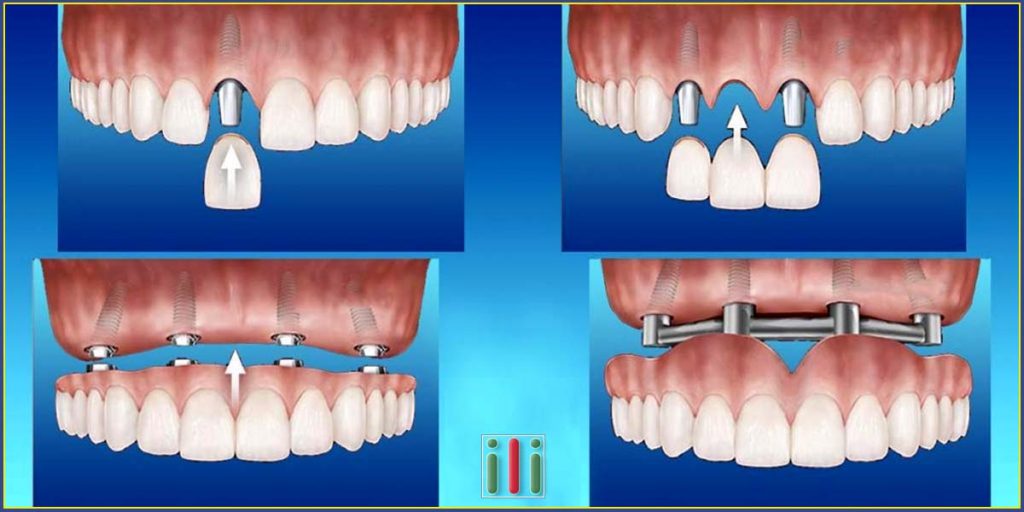
Areas of application of dental implants in dental prosthesis
Introduction
Dental implantation has become one of the most advanced and reliable methods for replacing missing teeth, offering stable, long-term solutions for patients who require anything from a single crown to a complete fixed denture. As the attached document notes, “the most important element of dental implantation is the dental implant itself,” a high‑purity titanium alloy structure that functions as an artificial tooth root. Modern implantology, supported by state‑of‑the‑art 3D imaging and improved surgical techniques, has transformed the way dentists restore chewing function, articulation, and overall oral health. This article explores the four most common areas where dental implantation is used, while also placing these solutions in context with today’s full‑mouth rehabilitation systems, including one‑phase implants, two‑phase implants, All‑on‑4, and All‑on‑6.
Understanding the role of dental implants
A dental implant is surgically placed into the jawbone, where it integrates with the bone and provides a stable foundation for various types of prosthetic restorations. Once healed, the implant can support a crown, a bridge, or even a complete fixed denture. The stability and durability of implants make them an excellent alternative to traditional removable dentures, which often lack comfort and long‑term reliability.
Dental implantation is used whenever one or more teeth are missing, and the goal is to restore proper chewing, speech, and aesthetics. The following sections outline the four primary application areas of dental implants in modern prosthetic dentistry.
Replacing a single missing tooth
One of the most common reasons for dental implantation is the replacement of a single missing tooth. In this case, a crown is placed on top of the implant, creating a natural‑looking and fully functional artificial tooth. When multiple individual teeth are missing in different locations, each can be replaced with its own implant‑supported crown.
This approach has several advantages:
— No need to grind down healthy adjacent teeth,
— Excellent long‑term stability,
— Natural appearance and function,
— Preservation of jawbone volume.
A key requirement is that the patient must have sufficient bone quality and quantity to support the implant. If bone loss is present, bone augmentation may be necessary before implantation.
Implant‑supported bridges
When several teeth are missing next to each other, an implant‑supported bridge is often the ideal solution. Instead of relying on natural teeth for support, the bridge is anchored to implants placed strategically in the jawbone. This eliminates the need to modify healthy teeth and provides a stable, long‑lasting restoration.
Implant‑supported bridges offer:
— Strong, stable support for multiple missing teeth,
— A natural appearance that blends with existing teeth,
— Improved chewing efficiency,
— Prevention of bone loss in the edentulous area.
This method is particularly beneficial when three or more adjacent teeth are missing, making traditional bridges less practical.
Fixed, complete dentures supported by implants
One of the most frequent reasons for dental implantation is the need for a full‑arch restoration, often referred to as a complete fixed denture. This solution is recommended for patients who have no teeth suitable for prosthetic treatment or who are completely edentulous. As the document explains, “the most common cause of dental implantation is a full bridge, also known as a complete denture.”
Fixed full dentures supported by implants offer several advantages:
— Suitable even in cases of significant bone deficiency,
— Eliminates problems associated with traditional removable dentures,
— No adhesive or glue required for stability,
— Provides maximum comfort and excellent functional performance,
— Can be completed with relatively simple surgical procedures.
In modern dentistry, full‑arch implant solutions are often performed using one‑phase implants, two‑phase implants, All‑on‑4, or All‑on‑6 systems. These methods differ in surgical approach, number of implants, and loading protocols, but all aim to provide a stable, fixed fogsor that restores full chewing ability.
Implant‑supported overdentures
Overdentures represent a hybrid solution between removable and fixed prosthetics. In this method, a metal bar or locator system is attached to the implants, and the denture snaps onto this structure. While the denture is removable, the implants provide significantly greater stability than traditional dentures.
Overdentures are typically used when bone volume is limited and a fully fixed solution is not feasible.
Their advantages include:
— Improved stability compared to traditional dentures,
— Easy removal for cleaning,
— Better chewing efficiency,
— Reduced pressure on the gums.
However, overdentures have become less popular in recent years because the attachment components can wear out over time, requiring periodic replacement. Despite this, they remain a valuable option for patients with minimal bone availability.
How modern implant systems fit into these four application areas
Today’s implantology offers several advanced systems that enhance the effectiveness of dental implantation across all four categories.
One‑phase implants — Immediate loading capability, — Suitable for patients with bone deficiency, — Often used in full‑arch rehabilitation.
Two‑phase implants — Traditional two‑step method, — Requires adequate bone volume, — Ideal for single crowns and bridges.
All‑on‑4 — Four implants supporting a full‑arch fixed denture, — Designed for moderate bone loss, — Immediate loading possible.
All‑on‑6 — Six implants for enhanced stability, — Recommended for stronger bone structure, — Excellent long‑term support for full‑arch restorations.
These systems ensure that dental implantation can be tailored to each patient’s anatomical and functional needs.
Summary
Dental implantation is a versatile and highly effective method for replacing missing teeth, offering stable, long‑term solutions across four primary application areas: single‑tooth replacement, implant‑supported bridges, fixed complete dentures, and implant‑supported overdentures. Each option provides unique benefits, from preserving healthy teeth to restoring full chewing function and preventing bone loss. Modern implant systems—including one‑phase implants, two‑phase implants, All‑on‑4, and All‑on‑6—further enhance these treatments by offering predictable, durable, and patient‑specific solutions. Although dental implantation may cost more than traditional dentures, its stability, natural appearance, and long‑term reliability make it an outstanding investment in oral health and overall quality of life.
In our Articles section, there are many writings on the following topics: dentures with implants, dental implantation with one-phase and two-phase implants, and All-On-4 & All-On-6 technology.
We work with state-of-the-art dental tools, materials, and technologies.
30 years of experience, more than 35,000 successful implant placements, and a 99.7% success rate!
iliDent Patient Coordinator © Copyright 2021
ImmediateLoadingImplants.com


