
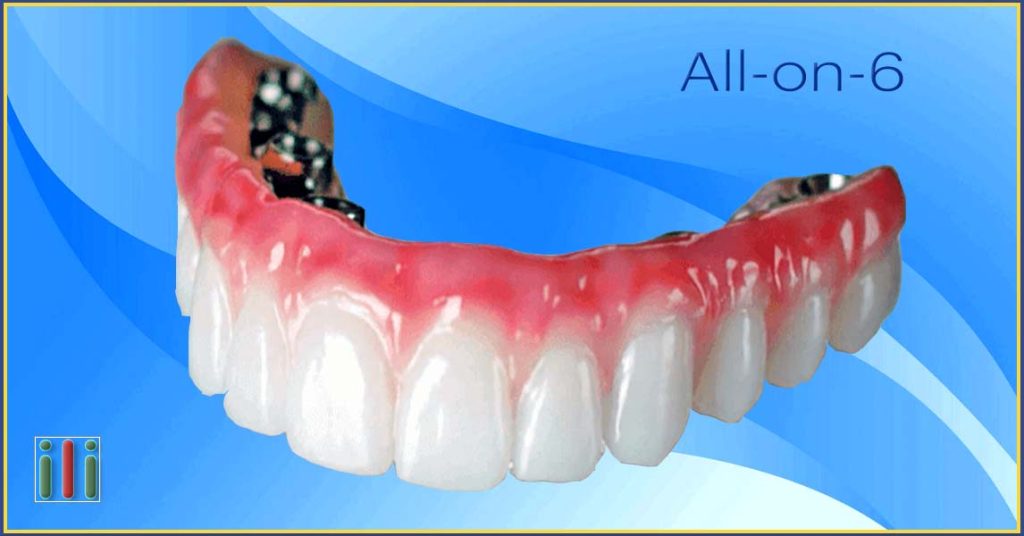
Fast and economical oral rehabilitation with All-on-6 tooth replacement
Introduction
Modern implant dentistry offers several advanced solutions for patients who have lost most or all of their natural teeth. Among these, all‑on‑6 tooth replacement has become a highly reliable and efficient method for restoring full‑arch function with a fixed, permanent denture. This treatment concept is designed for individuals who require complete oral rehabilitation and want a stable, long‑lasting alternative to removable dentures. In this article, we explore how all‑on‑6 tooth replacement works, who it is suitable for, how the treatment process unfolds, and what advantages it offers compared to other implant‑based solutions.
Understanding the all‑on‑6 concept
All‑on‑6 tooth replacement is an implant‑supported full‑arch restoration technique that uses six implants per jaw to anchor a fixed denture. The method is intended for patients whose remaining teeth are no longer suitable for long‑term dental treatment or who already experience complete tooth loss. Before the procedure, the implantologist carefully evaluates the patient’s bone structure and determines the optimal implant positions to ensure maximum stability and long‑term success.
The six implants are strategically placed across the jawbone, providing a strong and evenly distributed foundation for the final denture. This approach is particularly beneficial for patients who have moderate bone loss but still possess enough bone volume to support six implants without extensive grafting procedures.
All‑on‑4 vs. all‑on‑6: What is the difference?
Although both techniques are designed for full‑arch restoration, the main distinction lies in the number of implants used and the bone conditions required.
All‑on‑4 uses four implants per arch, with the two posterior implants placed at an angle to maximize bone contact. – All‑on‑6 uses six implants per arch, all positioned vertically, providing a broader support base.
All‑on‑4 is often recommended for patients with excellent bone quality and quantity, offering a faster and more economical solution. All‑on‑6, on the other hand, is ideal when the bone structure is adequate but not optimal for the angled‑implant approach. The additional implants enhance stability and load distribution, making the restoration more robust in cases where bone density is moderate.
The all‑on‑6 treatment process
All‑on‑6 tooth replacement follows a streamlined, three‑phase protocol that typically takes around three weeks to complete. The process is predictable, efficient, and designed to minimize patient discomfort while maximizing long‑term success.
1. First visit – Consultation, preparation, and implant placement
The first appointment includes a comprehensive examination, diagnostic imaging, and treatment planning. If necessary, non‑restorable teeth are removed during this visit. The implantologist then prepares the jawbone and places the six implants using a precise surgical technique. Local anesthesia is standard, but general anesthesia is available upon request.
2. Second visit – Follow‑up and impressions
Approximately one week later, the patient returns for suture removal and a post‑operative evaluation. X‑ray imaging is used to confirm implant stability. If healing is progressing normally, impressions are taken for the final denture. This ensures that the permanent restoration will fit accurately and function properly.
3. Third visit – Delivery of the permanent denture
Around three weeks after the initial surgery, the final denture—crafted from zirconia or porcelain—is attached to the implants. The restoration may be removable by the clinician or fully fixed, but in either case, it is not removable by the patient. Unlike traditional implant protocols, all‑on‑6 tooth replacement does not require a long‑term temporary denture; the patient receives the permanent restoration immediately at this stage.
Healing and adaptation period
Although the full‑arch restoration is fixed and functional from the first day, the body still needs time to heal. The initial healing period lasts only a few weeks, while the ossification process—during which the bone integrates with the implants—takes approximately 3–5 months. During the first weeks, patients should bite and chew carefully and avoid hard foods or excessive pressure on the new denture.
Adapting to the new denture varies from person to person. Some patients adjust quickly, while others need more time to feel completely comfortable. Mild discomfort or a foreign sensation is normal at first, but these symptoms gradually diminish as the mouth adapts. Regular check‑ups and following the clinician’s instructions ensure a smooth transition.
Advantages of all‑on‑6 tooth replacement
All‑on‑6 tooth replacement offers several benefits that make it an excellent choice for full‑arch rehabilitation.
Simplified surgical procedure – Although six implants are used, the surgery is straightforward and less invasive than traditional full‑arch implant methods that require 8–12 implants per jaw.
Fewer implants compared to older methods – Traditional implant‑supported dentures often require a large number of implants. All‑on‑6 reduces this number while still providing excellent stability.
Cost‑effective solution – Using fewer implants generally lowers the overall cost compared to older multi‑implant protocols.
Faster results – The final denture is delivered within approximately three weeks, significantly faster than traditional implant treatments that require months of healing before the permanent restoration can be placed.
High stability – The six implants provide a strong and evenly distributed support system, creating a stable foundation that can withstand normal chewing forces.
While all‑on‑6 tooth replacement is highly effective, it is not suitable for everyone.
Bone requirements – Adequate bone quality and quantity are essential. If the bone structure does not meet the necessary criteria and cannot be improved with bone grafting, the method may not be applicable.
Requires advanced expertise – Determining the correct implant positions and performing the surgery requires extensive training and experience. The procedure must be carried out by a qualified oral surgeon or implantologist.
Limited long‑term data – Although success rates are excellent, all‑on‑6 is a relatively new technique compared to traditional implant methods, so long‑term data is still evolving.
All‑on‑6 oral rehabilitation is typically offered at a package price that includes all necessary procedures, materials, and follow‑up appointments. This pricing model ensures transparency and eliminates hidden costs. The final price may vary depending on individual clinical factors, and an accurate quote can only be provided after reviewing a recent panoramic X‑ray.
Summary
All‑on‑6 tooth replacement is a highly effective and efficient solution for patients who require full‑arch restoration. With six implants providing strong support, a streamlined three‑week treatment protocol, and a durable, natural‑looking permanent denture, this method offers a reliable alternative to traditional implant‑based solutions. For individuals with adequate bone structure who want a stable, long‑lasting restoration, all‑on‑6 tooth replacement represents an excellent option. If you are considering this treatment, consult a qualified implantologist to determine whether it is the right choice for your needs.
In our Articles section, there are many writings on the following topics: dentures with implants, dental implantation with one-phase and two-phase implants, and All-On-4 & All-On-6 technology.
We work with state-of-the-art dental tools, materials, and technologies.
30 years of experience, more than 35,000 successful implant placements, and a 99.7% success rate!
iliDent Patient Coordinator © Copyright 2025
ImmediateLoadingImplants.com


