
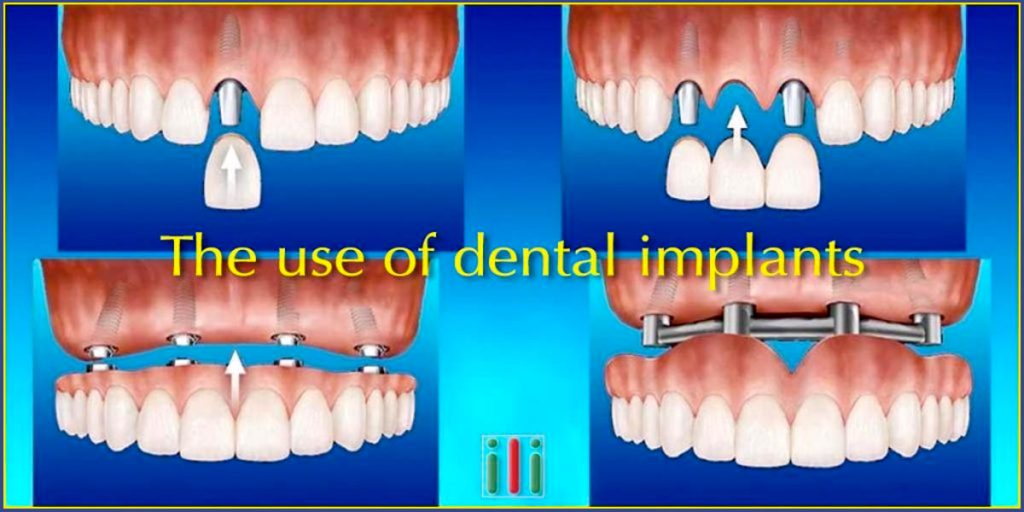
Dental implantation – The 3 most common use
Introduction
Dental implantation has become one of the most advanced and reliable solutions for replacing missing teeth, offering long-term stability, natural aesthetics, and restored chewing function. As modern dentistry continues to evolve, implant-based restorations are now used in a wide range of treatments, from single-tooth replacement to full denture rehabilitation. Understanding the most common uses of dental implantation helps patients make informed decisions about their oral health and choose the solution that best fits their needs. This article presents the primary implant types used today—immediately loaded one-phase implants, traditional two-phase implants, All‑on‑4 technology, and All‑on‑6 technology—and explains how each supports crowns, bridges, and complete dentures.
THE MOST COMMON DENTAL IMPLANTS
Immediate loadin, one-phase implant
The immediately loaded one-phase implant is a single-piece titanium implant designed for rapid stabilization and immediate functionality. Unlike traditional methods, this technique does not require opening the gums, as the surgeon determines the implant position precisely using imaging. The implant is placed in a single step, and a long-term temporary denture can often be completed within a few days. This method is especially suitable for patients with bone deficiency, as it can be used even when traditional implants are not recommended. Its simplicity, speed, and minimally invasive nature make it a popular choice for those seeking fast and efficient tooth replacement.
Traditional, two-phase implant
The traditional two-phase implant is the most widely used and clinically tested implant method. It involves two separate stages: first, the implant is inserted into the bone beneath the gums, and the area is sutured to allow healing. Over the next 4–6 months, the implant integrates with the bone. After ossification, the gums are reopened to attach the abutment and prepare the final denture. This method offers exceptional stability and long-term success, making it ideal for patients with adequate bone volume who prefer a conventional, step-by-step approach. Its reliability is supported by decades of clinical experience.
All‑on‑4 technology
The All-on-4 system is a full-arch reconstruction method that uses four strategically placed implants to support the entire denture. The posterior implants are placed obliquely to maximize bone contact, making the technique suitable for patients with even moderate bone loss. One of the main advantages of All-on-4 is that at the end of the restoration process, the patient receives a permanent denture. That means the patient can leave the clinic with a fixed, permanent denture around day 20. This method provides excellent stability, improved chewing ability, and a natural appearance, making it a cost-effective alternative to a full denture.
All‑on‑6 technology
The All‑on‑6 system is similar to All‑on‑4 but uses six implants instead of four, offering increased stability and load distribution. This method is ideal for patients with sufficient bone volume who want a highly durable and long-lasting full denture solution. The additional implants provide enhanced support, reduce stress on individual implant sites, and improve long-term performance. All‑on‑6 restorations are known for their exceptional strength and comfort, making them suitable for patients who require a robust solution for heavy chewing forces.
AREAS OF USE OF DENTAL IMPLANTS
Crown – replacing a single tooth
When only one tooth is missing, a dental implant is the most effective and conservative solution. Instead of grinding down healthy neighboring teeth to support a bridge, a single implant can be placed to hold a crown that matches the natural teeth in color and shape. Both immediately loaded one-phase implants and traditional two-phase implants can be used for single-tooth replacement, depending on bone quality and the patient’s overall oral health. The result is a stable, natural-looking crown that restores full chewing function without compromising adjacent teeth.
Bridge – replacing multiple teeth
When several teeth are missing in a row, an implant-supported bridge offers a strong and aesthetic solution. Instead of placing an implant for every missing tooth, two or more implants can support a multi-unit bridge. This approach reduces the number of implants needed while still providing excellent stability. Traditional two-phase implants are commonly used for implant-supported bridges due to their long-term reliability, but one-phase implants may also be suitable in cases of bone deficiency. Implant-supported bridges prevent shifting of remaining teeth, restore chewing ability, and maintain jawbone health.
Round bridge or full denture – replacing all teeth
For patients who have lost most or all of their teeth, implant-supported full dentures offer the highest level of stability and comfort. Depending on bone volume and individual needs, All‑on‑4 or All‑on‑6 technology is typically used. These systems allow a complete denture to be fixed securely to the implants, eliminating the discomfort and instability associated with traditional removable dentures. A round bridge or full denture supported by implants provides strong chewing ability, natural aesthetics, and long-term durability. In many cases, a temporary denture can be attached immediately, allowing patients to regain function quickly.
Summary
Dental implantation plays a central role in modern tooth replacement, offering solutions for single-tooth loss, multiple missing teeth, and complete denture restoration. Whether using immediately loaded one-phase implants, traditional two-phase implants, All‑on‑4, or All‑on‑6 technology, implant-based treatments provide stability, comfort, and natural aesthetics. Crowns, bridges, and full dentures supported by implants help maintain jawbone health, restore chewing ability, and improve overall quality of life. By understanding the most common uses of dental implantation, patients can choose the method that best meets their needs and ensures long-term oral health.
In our Articles section, there are many writings on the following topics: dentures with implants, dental implantation with one-phase and two-phase implants, and All-On-4 & All-On-6 technology.
We work with state-of-the-art dental tools, materials, and technologies.
30 years of experience, more than 35,000 successful implant placements, and a 99.7% success rate!
iliDent Patient Coordinator © Copyright 2020
ImmediateLoadingImplants.com